
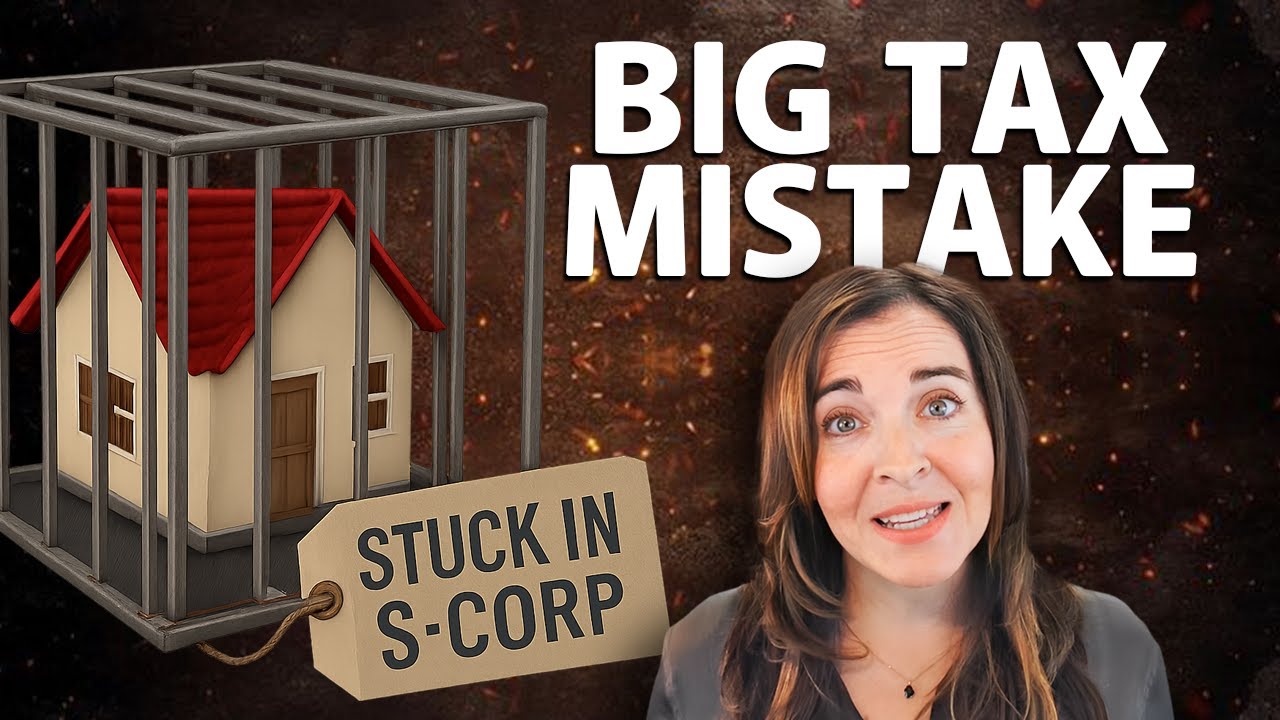
If someone recently told you to put your rental property inside an S corporation, it’s worth pausing before you make that move. S corps can be very effective for taxes in the right context — but for long-term rentals, this structure can quietly erase decades of tax benefits you will never recover.
You’re not alone if this is confusing. Entity structure is one of the most misunderstood areas of real estate tax planning. Let’s break down exactly what’s at stake.
Why Are S Corporations a Problem for Rental Properties?
You’re S corporations are genuinely powerful tools — just not for this purpose. They’re built for active income: service businesses, sales, commissions, construction, consulting. In those situations, an S corp can save you real money on self-employment taxes.
But long-term rentals work differently. In most cases, rental income is treated as passive under IRS rules, so there’s no self-employment or payroll tax to save — which means the usual S corp wage vs. distribution strategy often doesn’t add value here. What you're left with are the downsides — and
there are significant ones.
Many business owners discover this mismatch after the property is already inside the S corp, which makes the situation much harder to fix. The sooner you know, the more options you have.
What Happens If I Want to Take the Property Back Out Later?
This is one of the most painful surprises we see. Once a property is sitting inside an S corporation, getting it back out is not a simple process.
Removing real property from an S corp is typically treated as a taxable distribution. That means:
- The transfer is treated as if the corporation sold the property to you at fair market value
- Any appreciation since you put it in triggers capital gains tax — even though the property never actually sold
- Even a routine title cleanup can accidentally become a taxable event
We’ve seen clients who simply wanted to refinance or restructure — not sell — and found themselves facing an unexpected tax bill just from moving the paperwork. It's a frustrating situation, and it’s completely avoidable with the right structure from the start.
We met one investor who put a long held duplex into an S corporation on the advice of a friend, thinking it would be “more professional” and save taxes. Years later, they wanted to move the property into an LLC for estate planning and lending reasons, without actually selling it. When we modeled the change, the deemed sale inside the S corp generated a six figure tax bill, even though no cash changed hands. In the end, they decided to leave the property where it was and plan around the mistake — but they were stuck with far fewer options than if the right entity had been chosen from the beginning.
What Should I Do If My Property Is Already in an S Corporation?
First, don’t panic — and please don’t try to fix it yourself. Unwinding a property from an S corp requires careful planning to minimize the tax hit. In some cases there are strategies that reduce the damage; in others, it may make more sense to hold in place and plan around it.
The IRS guidance on S corporation distributions makes clear these transactions are closely scrutinized. A misstep can trigger taxes you weren’t expecting.
A few practical next steps:
- Get a professional review of your current structure before making any changes
- Understand your current basis and what a distribution would actually cost you today
- Model the long-term cost of staying versus restructuring, so you can make an informed decision
Many clients come to us feeling embarrassed that they set things up “wrong.” Please know — this is incredibly common, and it usually happened because someone gave well-meaning advice without fully understanding the rental property rules. That’s not a failure. That’s just not having the right information yet.
How Can We Help You Build the Right Structure From the Start?
At J.R. Martin & Associates, we work with real estate investors and business owners who want to grow their portfolio the right way — with a structure that protects deductions, preserves wealth, and transfers cleanly to the next generation.
Our services include:
- Entity structure consulting — finding the right fit for your specific properties and goals
- Real estate tax planning — maximizing depreciation, passive losses, and long-term benefits
- Estate and succession planning — making sure your heirs inherit the full value of what you’ve built
- Bookkeeping and tax preparation — keeping everything compliant as your portfolio grows
You’ve worked hard to build real estate wealth. Let’s make sure the structure you’re using actually supports that goal.
We’re here to help. Reach out to schedule a consultation, and let’s take a look at where you stand. You don’t have to handle this alone.
What Is the “Basis Trap” and Why Does It Matter?
This one catches a lot of real estate investors off guard.
When you own property through a properly structured LLC taxed as a partnership, your tax basis in the partnership can increase with your share of the debt on the property. So even when a rental shows a paper loss from depreciation, you can often use that loss to offset other income.
Inside an S corporation, the mortgage stays with the corporation, not you personally. Your shareholder basis doesn’t include that debt, so your loss deductions freeze until you inject more cash or lend directly to the corp.
Over years of ownership, this can cost tens of thousands of dollars in deductions you were counting on.
How Does This Affect What My Heirs Inherit?
This is the part that surprises even experienced investors. The estate planning consequences of holding rental property in an S corporation can be severe — and they’re largely irreversible.
Here’s how it works when property is held correctly in an LLC:
When you pass away, your heirs receive a full step-up in basis to the property’s current fair market value. They can restart the depreciation clock at today’s value — potentially generating hundreds of thousands in future deductions. If they sell shortly after inheriting, they owe little to no capital gains tax.
When property is held inside an S corporation, your heirs inherit stock — not the real estate itself. The property’s inside basis inside the S corp often stays low, and when the S corp eventually sells, it can end up paying tax on years of depreciation and appreciation that might have been largely eliminated with a direct step-up in basis.
That missed step-up can erase hundreds of thousands of dollars in future deductions — wealth that could have stayed in your family.
Are There Any Situations Where an S Corp Makes Sense for Real Estate?
There are narrow exceptions. If you run an active real estate business — house flipping, development, or high-volume wholesaling — an S corp may make sense for the operational side. Short-term rentals involving substantial services can sometimes qualify as active income under IRS rules, too.
But for most landlords holding single-family homes, small multifamily, or commercial rentals for steady passive income — the S corp creates more problems than it solves. In many cases, an LLC is the better fit.
If you’re not sure which category your situation falls into, that’s exactly the kind of question worth answering before setting up any entity.